A layered cybersecurity strategy is defined as a multi-level defence model that applies overlapping security controls across technology, people, and processes to protect business data and reduce risk. For small and mid-sized businesses, this approach is the most effective way to stop threats that bypass any single control. The industry term for this model is “defence in depth,” and it maps directly to the NIST Cybersecurity Framework 2.0, which organises security activities into six core functions: Govern, Identify, Protect, Detect, Respond, and Recover. When you implement a layered cybersecurity strategy correctly, you reduce the chance that one failure brings down your entire operation.
A multi-layered security approach works because each layer compensates for the weaknesses of the others. No single tool stops every threat. Firewalls block unwanted traffic at the perimeter, but they cannot stop a phishing email that tricks an employee into handing over credentials. That is why you need controls at every level.
The core cybersecurity defence layers for SMBs are:
| Layer | Primary control | What it protects against |
|---|---|---|
| Perimeter | Firewall, IPS | External network intrusions |
| Endpoint | EDR, antivirus | Malware, ransomware on devices |
| Identity | MFA, password policy | Credential theft, unauthorised access |
| Data | Encryption, backups | Data loss, ransomware extortion |
| Human | Security awareness training | Phishing, social engineering |
Pro Tip: Start with MFA and backups before anything else. These two controls deliver the highest protection per dollar spent and can be activated within days.
Preparation prevents wasted spending. Businesses that skip this step often buy tools that duplicate each other or miss critical gaps entirely.
Follow these steps before you deploy any new security controls:
Pro Tip: A one-page risk matrix is enough to start. List your top ten assets, score each threat from 1–5 for likelihood and impact, and multiply the scores. Address anything above 15 first.
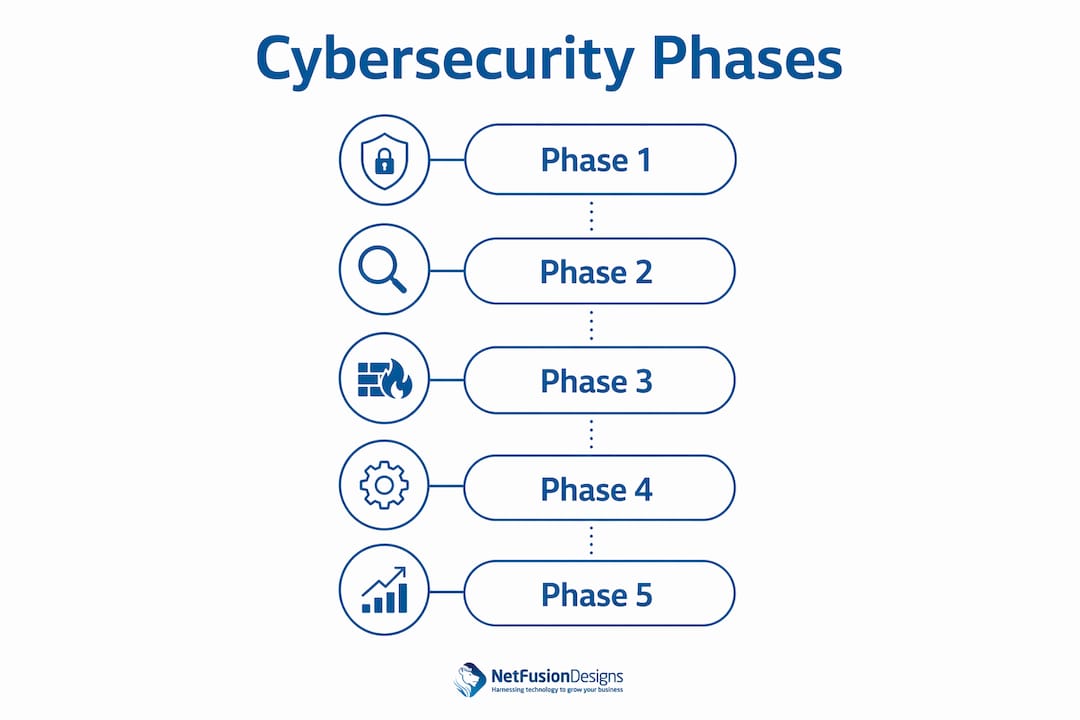
A phased, 6-month roadmap is the most budget-conscious way for SMBs to build enterprise-grade security without overwhelming their teams or finances. Breaking implementation into three phases lets you build on each layer before adding the next.
Foundational controls like MFA, patching, and backups can deliver meaningful protection and compliance alignment within 15–30 days. That speed matters when threats are active.
Basic SIEM or managed detection services help SMBs identify threats before they escalate into full breaches. Early detection is far cheaper than recovery.
| Phase | Timeline | Key outcome |
|---|---|---|
| Foundational | Months 1–2 | MFA, backups, endpoint protection active |
| Monitoring | Months 3–4 | Threats detected early, email secured |
| Advanced | Months 5–6 | DLP, audits, tested response plan |
Pro Tip: Do not wait until Phase 3 to test your backups. Restore a test file at the end of month 1 to confirm your backup system actually works.
The right tools make your defence layers work together. The wrong tools create gaps or redundancies that cost money without adding protection. Resources like Cyber Defense Magazine track which categories of tools deliver the most consistent results for businesses of your size.
The core tool categories every SMB needs are:
Beyond tools, three practices determine whether your defence holds:
Regular patching is non-negotiable. Unpatched software is the most common attack vector after phishing. Set a weekly patch review cycle and automate where possible.

Security awareness training needs to happen more than once a year. Even annual practical training sessions improve defence by addressing the human factor. Quarterly short sessions with simulated phishing tests produce better results than a single annual lecture.
Policy enforcement closes the gap between what your tools can do and what your staff actually does. A password policy that nobody follows provides no protection. Enforce policies through technical controls, such as requiring password managers and blocking weak passwords at the system level, rather than relying on goodwill. You can find enterprise-grade security tools reviewed in detail to help you match tools to your specific risk profile.
Most SMB cybersecurity failures trace back to a small set of avoidable mistakes. Knowing them in advance saves you time and money.
Common pitfalls include neglecting governance, skipping asset inventories, misallocating budget, and ignoring continuous updates. Each one creates a gap that attackers exploit.
Pro Tip: Schedule a 30-minute security review every quarter. Check your backup logs, review user access lists, and confirm your patches are current. This single habit catches most drift before it becomes a breach.
If your business has already experienced an incident, emergency ransomware recovery services can help you restore operations quickly while you build a stronger defence going forward.
A layered cybersecurity strategy built on the NIST Cybersecurity Framework 2.0 gives SMBs the most practical and affordable path to genuine, sustained data protection.
| Point | Details |
|---|---|
| Start with fundamentals | Activate MFA and automated backups before deploying any advanced tools. |
| Use NIST CSF 2.0 as your guide | The six core functions (Govern, Identify, Protect, Detect, Respond, Recover) structure every decision. |
| Phase your implementation | A 6-month roadmap prevents budget strain and builds each layer on a solid foundation. |
| Train staff regularly | Quarterly phishing simulations and awareness sessions address the human factor effectively. |
| Monitor and review continuously | Quarterly security reviews catch configuration drift and new vulnerabilities before attackers do. |
The businesses I see struggle most with cybersecurity are not the ones with the smallest budgets. They are the ones waiting for the perfect moment to start. They want a complete plan, a dedicated IT team, and a clear ROI before they act. That moment rarely arrives.
What I have found is that the gap between a vulnerable SMB and a well-defended one is usually just three things: MFA on every account, working backups tested monthly, and one person who owns the security file. Those three controls stop the majority of attacks that hit small businesses. Everything else, the SIEM, the DLP, the penetration testing, builds on that foundation.
The NIST CSF 2.0 framework is genuinely useful here because it gives you a language for security that does not require a computer science degree. The Govern function, added in 2024, is the most underrated addition. It forces leadership to treat security as a business decision, not an IT problem. That shift in ownership changes everything.
My honest advice: do not wait for a breach to take this seriously. Build the foundation this quarter, add monitoring next quarter, and treat security as a process you improve continuously. The IT support options for SMBs available today make this more accessible than it has ever been.
— Geeshan
NetFusion Designs Inc is a SOC 2 Type 2 attested managed IT provider serving SMBs across Ontario and Canada. The team delivers fully managed cybersecurity, including 24/7 monitoring, endpoint protection, MFA deployment, and incident response, without requiring you to hire an internal security team.

Whether you are starting from scratch or filling gaps in an existing setup, NetFusion Designs Inc matches your risk profile to the right controls. The cybersecurity and antivirus services cover the full defence stack, from perimeter to endpoint to data protection. For businesses in the greater Toronto area, managed IT services in Mississauga provide local, enterprise-grade support tailored to your size and industry. Contact NetFusion Designs Inc to schedule a security assessment and get a clear picture of where your business stands today.
A layered cybersecurity strategy, also called defence in depth, applies multiple overlapping security controls across technology, people, and processes. No single layer stops every threat, so each layer compensates for the weaknesses of the others.
The NIST Cybersecurity Framework 2.0 is a government-developed guide that organises cybersecurity activities into six core functions: Govern, Identify, Protect, Detect, Respond, and Recover. The Govern function was added in 2024 to make leadership accountability a formal part of the framework.
A phased 6-month roadmap is the most practical approach. Foundational controls like MFA and backups can be active within 15–30 days, with monitoring and advanced detection added in subsequent phases.
Assign one person as accountable for security decisions, then complete an asset inventory and risk assessment. Without knowing what you have and who owns the file, every tool purchase is a guess.
A quarterly security review covering backup logs, user access lists, and patch status is the minimum. Incident response plans should be tested at least once a year through a tabletop exercise.
%20(1).avif)
%201.avif)